


Animal welfare is our welfare
Serengeti-Park Department of Research SPDR
With an increased call for research at the Serengeti-Park Hodenhagen GmbH, the Serengeti-Park Department of Research (SPDR) was created in January 2018. The SPDR is committed to interdisciplinary approaches to biological, physiological, psychological and veterinary research. SPDR operates, supports and promotes scientific research projects that directly or indirectly serve the overall vision of the Serengeti-Park Hodenhagen GmbH and its mission to be innovative and goal oriented towards the future. The Serengeti-Park Hodenhagen GmbH is currently home to approximately 2000 animals from more than 80 species. Many of these animals are endangered in the wild and are enrolled in captive breeding programs.
Objectives
By examining the influence that the external and internal environment has on the animals and on visitor awareness, we have defined our main objectives as follows:
Facilitating and initiating research projects that are vital to the conservation and welfare of animal species in our care, including those at risk of extinction in the wild and those that play an important role in the social structure and ecosystem.
Increasing support and promotion for research projects involving domestic and endangered species through financial means and shared basic scientific knowledge stemming from published and unpublished reports.
Encouraging cooperation with Universities and Institutes with the goal of creating a network of research and conservation efforts.
Improving public attitudes towards animals and conservation, as visitors may leave each visit more committed to the protection of nature.
SPDR, through scientific research projects, has the priority to ensure the animal welfare of the Serengeti-Park’s animal collection by working closely with administrative staff, veterinarians, biologists, zoologists and animal keepers.
This knowledge can ultimately be used towards the conservation of species biodiversity, and in decision-making that directly impacts the management of animals in our care, which can create a legacy in the years to come.
Research Project Areas
Stress management

Physiology & endocrine response
Cognitive research

Enrichment & training
Population biology

Reproduction & genetics
Ecology & nutrition

Behavior typical of the species

Social learning & social structure
Parasitology

Parasite-host interactions
Social science

Conservation physiology &
Conservation psychology
In addition to the observational data, non-invasive samples from the wildlife stock at the Serengeti-Park, can be made available to the research following compliance with Germany and EU legal requirements, veterinary regulations, and adherence to the ethics and principles of the European Association of Zoos and Aquaria (EAZA).
Description internship program
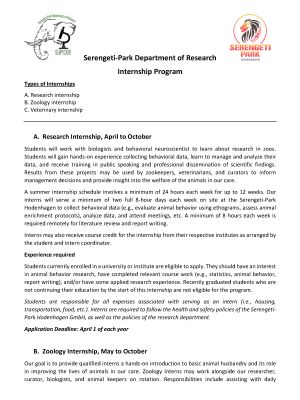
We offer different types of internships. Information in description
Chowanietz, F. (2022)
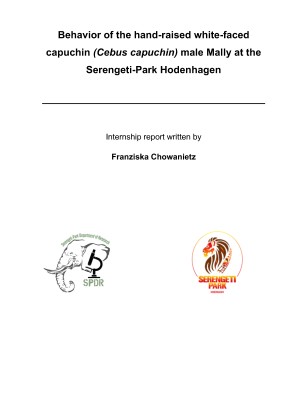
Behavior of the hand-raised white-faced capuchin male Mally
Chowanietz, F. (2022)
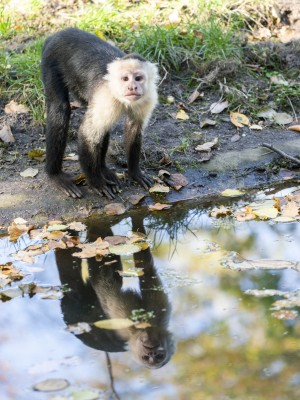
Internship Presentation: Behavior of the hand-raised white-faced capuchin Mally
Kollmar, M. (2022)
Social behavior of young elephant male during interactions with the herd
Kränzlin, M. (2021)
Feeding behavior of visitors at the Serengeti-Park Hodenhagen
(full report upon request)
Casper, K.R., Pallasdies, F., Mader, L., Sartorelli, H., Begall, S. (2022)
The evolution and biological correlates of hand preferences in anthropoid primates.
Hess, A. (2021)
Lesions found in the post-mortem reports of the Asian and African elephants of the EAZA.
Wehrenberg, G. (2020)
Development of a standardised SNP panel for genetic assessment of population structure in European bison.
Chances for Nature e.V. (2021)
Successful infrasound test with elephants
Wehrenberg, G., Tokarska, M., Cocchiararo, B., Nowak, C. (2024)
A reduced SNP panel optimised for non-invasive genetic assessment of a genetically impoverished conservation icon, the European bison
Kleinlugtenbelt C., Burkevica A., Clauss M. (2023)
Large carnivore feeding in European zoos.
Kleinlugtenbelt C., Clauss M., Burkevica A., De Cuyper A. (2023)
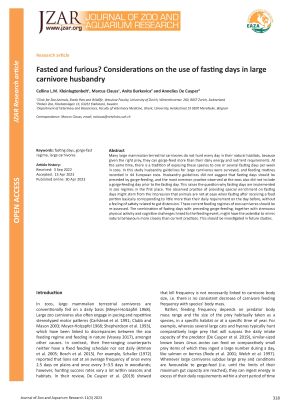
Fasted and furious? Considerations on the use of fasting days in large carnivore husbandry.
Kleinlugtenbelt C., Burkevica A., Clauss M. (2023)
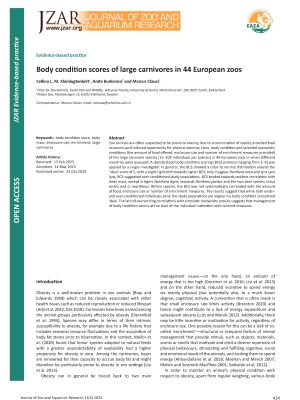
Body condition scores of large carnivores in 44 European zoos.
Kränzlin, M., Azogu-Sepe, I., Pouydebat, E. and Böhmer, C. (2024)
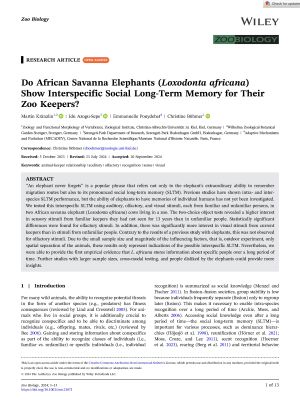
Do African Savanna Elephants (Loxodonta africana) Show Interspecific Social Long-Term Memory for Their Zoo Keepers?
Rauch-Schmücking, H., Bohner, J., Goeritz, F., Bakker, D., Stalder, G., Stenvinkel, P., Johnson, R. J., Shiels, P. G., Redtenbacher, I., Azogu-Sepe, I., Burgener, I. A., & Painer-Gigler, J. (2024)
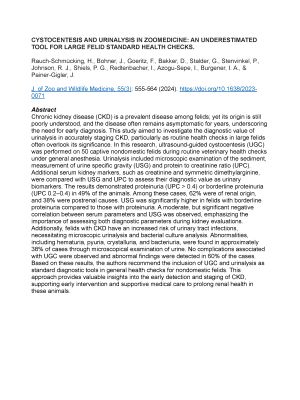
Cystocentesis and urinalysis in zoomedicine: an underestimated tool for large felid standard health checks.
Hörner F., Lawrenz A., Oerke A.-K., Müller D.W.H., Azogu-Sepe I., Roller M., Damerau K., Preisfeld A. (2023)
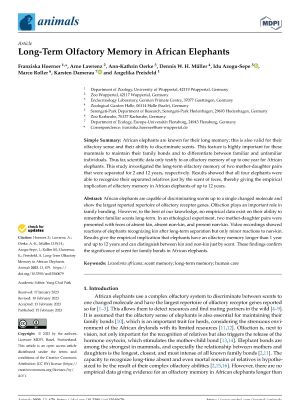
Long-term olfactory memory in African elephants
Bohner J., Painer J., Bakker D., Haw A.J., Rauch H., Greunz E.M., Egner B., Goeritz F. (2022)
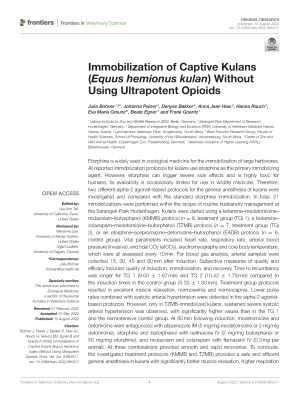
Immobilization of Captive Kulans (Equus hemionus kulan) Without Using Ultrapotent Opioids
Hermes R., Lecu A., Potier R., Goeritz F., Rickard J.P., Bohner J., Wedlarski R., Hruby J., Hildebrandt T.B. (2022)
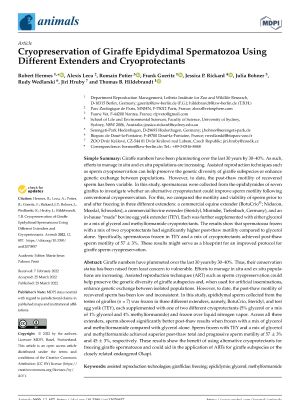
Cryopreservation of Giraffe Epidydimal Spermatozoa Using Different Extenders and Cryoprotectants
Azogu-Sepe, I., Plamondon, H. (2021)
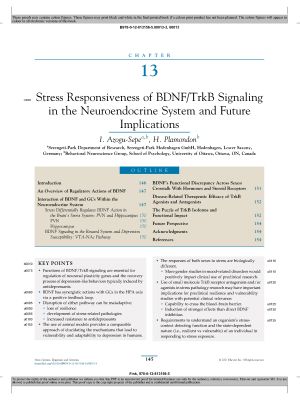
Stress Responsiveness of BDNF/TrkB Signaling in the Neuroendocrine System and Future Implications
Hörner F., Oerke A.-K., Müller D.W.H., Westerhüs U., Azogu-Sepe I., Hruby J., Preisfeld G. (2021)
Monitoring behaviour in African Elephants during introduction into a new group
Eikelberg D.J., Allnoch L., Grothmann P., Bohner J., Hewicker-Trautwein M. (2020)
Subcutaneous fibrosarcomas with pulmonary metastases in a white tiger (Panthera tigris) and a lion (Panthera leo)
Greunz e.m., Krogh A.K.H., Pieters W., Ruiz O.A., Bohner J., Reckendorf A., Monaco D., Bertelsen M.F. (2018)
The acute-phase and hemostatic response in dromedary camels (Camelus dromedarius)
We encourage cooperation with Universities and Institutes for a wide range of research topics, as we provide a unique opportunity to assess and monitor species and their biology that may not be possible to do in the wild. Ex situ projects (outside the natural habitat) are aimed at developing informative data for the management of captive animal populations, focusing mainly on issues of conservation, education, welfare and husbandry. These can be implemented through bachelor, masters and doctoral thesis and degrees.
As the SPDR further develops, we aim to engage in in situ (within the natural habitat) research projects that will promote and/or support shared scientific knowledge about the coexistence between people and wildlife, species’ biodiversity and sustainability, and environmental influences.
SPDR Research Policy
Please read the SPDR Research Policy carefully and complete the relevant application documents.
Research Proposal Form
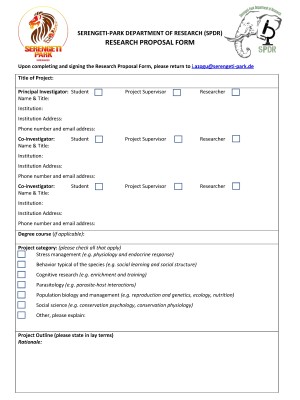
For on-site projects requiring data (such as film footage for research purposes, behavioral data)
Biological Samples Request Form
If requesting biological samples only (e.g. hair, faeces, urine)
For on-site projects requiring biological samples and other types of data, please complete the Biological Samples Request Form and the Research Proposal Form.
Böer, M., Thien, W., Tölke, D. (2000)
Surveying a zoological facility using satellite-based geodesy (German)
Böer, M., Schöne, J., Schneider, M.A., Hackenbroich, Ch. (2002)
On medetomidine-ketamine distance anesthesia of the Asiatic wild dog (German)
Böer, M. (2000)
Adaptation phenomena in reproduction & behavior of great apes in enclosures (German)
Böer, M., Hamza, H. (1996)
Keeping and breeding the white rhinoceros (German)
Reiners, J., Loth, K. (2014)
Risk factors for anesthesia of equine antelopes (Hippotragus equinus) under field conditions (German)
Fan, X., Sangpakdee, W., Tanomtong, A., Chaveerach, A., Pinthong, K., Pornnarong, S., Supiwong, W., Trifonov, V., Hovhannisyan, G., Loth, K., Hensel, C., Liehr, T., Weise, A. (2014)
Comprehensive molecular cytogenetic analysis of Barbary macaque (Macaca sylvanus)
Loth, K., Reiners, J. (2014)
A new approach to the safe anaesthesia of antelopes and gazelles
Our research center informs park-guests about the results of our projects
6th International Meeting on Zoo Research, Conservation and Biodiversity
Save the date: March 17 - 20, 2027
International Meeting on Zoo Research, Conservation and Biodiversity
The yearly conference, “International Meeting on Zoo Research, Conservation and Biodiversity”, was formed to provide a platform for scientists, academia, zoo researchers and all persons interested to discuss and exchange information on new science-based innovations and research topics that will offer perspectives and future-oriented solutions to biodiversity changes, while also addressing environmental sustainability.
Download Post-Conference Reports
Support
To finance its research, the SPDR largely depends on internal funding from the Serengeti-Park Hodenhagen GmbH, and on company sponsors.
If you are interested in collaborating on a project with the Serengeti-Park Department of Research or in providing support for our research projects, please contact us.
Contact
Chief of Department of Research
EAZA Research Committee Core Member
Serengeti-Park
Department of Research (SPDR)
Tel.: +49 (0) 5164 / 9799 – 444